Choosing the Right Business Structure for Your E2 Visa: LLC vs. S-Corp
Date: February 9, 2026, Category: Blog, E2 Visa Accounting
For Canadian entrepreneurs looking to expand into the U.S. market, the E2 Treaty Investor Visa remains the gold standard. It offers a path to live and work in the U.S. based on a substantial business investment. However, before you book your interview at the U.S. Consulate in Toronto, you face a critical legal decision: Should you form an LLC or an S-Corp?
While this might seem like a simple tax preference, the wrong choice can lead to IRS penalties or, worse, a denial of your E2 visa application. In 2026, with tighter scrutiny on at-risk investments and tax residency, understanding these structures is more important than ever.
The LLC: The Flexible Favorite for E2 Investors
The Limited Liability Company (LLC) is the most popular choice for E2 visa startups. It is a hybrid entity that combines the liability protection of a corporation with the tax flexibility of a partnership.
Why LLCs Work for E2 Applicants:
- No Ownership Restrictions: Unlike S-Corps, LLCs have no restrictions on the nationality or residency of the owners. This is vital because, during your initial application, you are not yet a U.S. resident.
- Pass-Through Taxation: By default, an LLC doesn’t pay federal income tax. Instead, profits and losses “pass through” to your personal tax return.
- Operational Simplicity: LLCs require less “corporate fluff.” While you don’t need a Board of Directors, a formal Operating Agreement is strictly required for your E2 petition.
The S-Corp: The Tax-Saving Trap?
An S-Corp is not a type of business entity; it is a tax election made with the IRS. While it saves money on self-employment taxes, it has a major eligibility hurdle for foreign investors.
The Eligibility Hurdle: To be a shareholder in an S-Corp, the IRS requires you to be a “Resident Alien” for tax purposes.
- The Conflict: When you first apply from Canada, you are a Non-Resident Alien. Forming an S-Corp too early can violate IRS rules because you haven’t yet passed the Substantial Presence Test.
- The Risk: Filing for S-Corp status prematurely can lead to your election being invalidated, causing back taxes and issues during your E2 visa renewal.
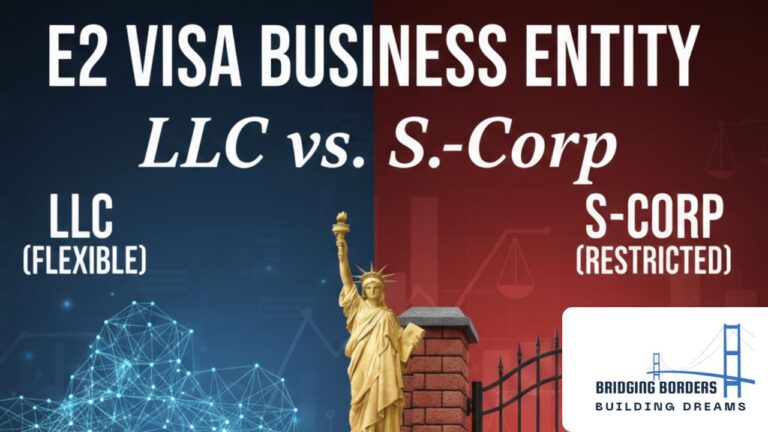
Key Comparison: LLC vs. S-Corp for E2 Visa
| Feature | LLC (Default) | S-Corporation Election |
|---|---|---|
| Eligibility | Open to all nationalities. | Must be a U.S. Tax Resident. |
| Tax Treatment | Pass-through; self-employment tax applies. | Pass-through; savings on distributions. |
| Compliance | Minimal; Operating Agreement is key. | High; requires formal minutes & payroll. |
| E2 Suitability | Best for Initial Applications. | Best for Future Tax Planning. |
2026 Strategy: The “LLC-to-S-Corp” Pivot
The smartest move for most Canadian E2 investors is to start as an LLC. Once you have lived in the U.S. for at least 183 days and established tax residency, you can file IRS Form 2553 to elect S-Corp taxation. This “pivot” is a core strategy we recommend at cpa for E-2 Visa.
The “At-Risk” Investment Requirement
Your investment must be “at-risk” meaning it is irrevocably committed before you apply.
- LLCs: Prove personal capital is at stake via the Operating Agreement.
- Corporations: Ensure share certificates and capital contributions are clearly documented.
- Proportionality: The investment must be “substantial” relative to the business cost.
Ready to Secure Your E2 Visa?
Choosing the right legal foundation is the first step toward a successful life in the United States. Don’t let a “simple” tax choice derail your American Dream.
Contact e2visa.ca today for a comprehensive review of your business plan and entity structure. Let’s ensure your investment is protected and your application is bulletproof.
Frequently Asked Questions
Yes. You can change your tax election (e.g., electing S-Corp status for your LLC) once you meet tax residency requirements. However, if you change the fundamental nature of the business, you may need to notify USCIS or the Consulate.
Yes. If you elect S-Corp status, the IRS requires you to pay yourself a "reasonable salary" via W-2 payroll. This is actually helpful for E2 visa renewals, as it provides clear evidence that the business is not marginal and is successfully supporting the investor.
Technically, you can form the entity without one, but for the E2 visa requirements, you must have a U.S. business bank account to show the irrevocable commitment of funds.
Yes, but the Treaty Investor (you) must still prove they "develop and direct" the U.S. entity. Often, it is cleaner for the individual Canadian citizen to own at least 50% of the U.S. entity directly to satisfy the nationality requirement.
Both structures allow you to hire U.S. workers. However, S-Corps have more rigid payroll requirements. Since the E2 visa requires you to show job creation, having a formal payroll system in place is a major plus.
